We are open May 6th - October 8th 2022. Please book directly with us via our website! We look forward to welcoming you at our beautiful place on Cape Cod.

What plants support pollinators on Cape Cod from spring to fall?
Spring bloomers like Beach Plum and Witch Hazel feed early bees; summer plants like Butterfly Weed, Milkweed, and Hydrangeas support butterflies and hummingbirds; and fall bloomers like Goldenrod and Asters fuel migrating Monarchs.
How can homeowners help support pollinators on Cape Cod?
Plant native species, leave leaf litter and stems in place, reduce chemical use, limit fall cleanup, and provide shallow water dishes for bees and butterflies.
Why are pollinators so active in spring on Cape Cod?
Warmer temperatures trigger queen bumblebees, early butterflies, and native ground‑nesting bees to emerge and search for early‑season nectar.
How is climate change affecting pollinators on Cape Cod?
Warmer seasons and shifting bloom times are creating timing mismatches between plant flowering and insect emergence, while drought reduces nectar availability.
Where can I stay near Cape Cod’s native plant gardens and wildlife sanctuaries?
A Little Inn on Pleasant Bay offers easy access to pollinator habitats, plus concierge guidance for nature outings.
•••
Cape Cod's pollinator habitats are shaped by seasonal changes from spring to fall, supporting bees, butterflies, hummingbirds, and other insects. Native plants like Beach Plum, Goldenrod, and Asters provide vital nectar and pollen while adapting to the region's sandy, acidic soils. These plants not only sustain pollinators but also benefit local agriculture, such as blueberry and cherry crops, which depend on them for pollination.
Key points:
Climate changes are altering bloom cycles and pollinator behaviors, but Cape Cod communities are creating native plant corridors and reducing habitat disruptions to support these ecosystems. By planting native species and minimizing garden cleanup, residents can help sustain pollinators year-round.
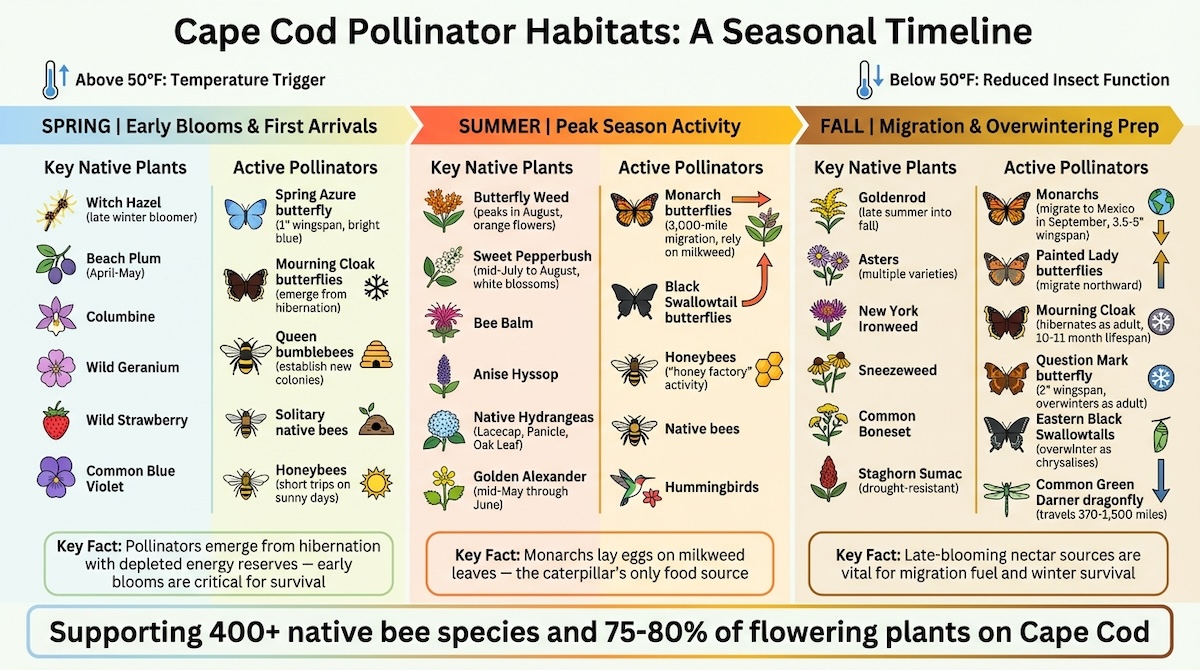
When temperatures creep above 50°F in early spring, Cape Cod’s native plants begin to stir. One of the first to bloom is Witch Hazel, which provides nectar during late winter - a critical time when food is scarce[1]. This early bloom is a lifeline for pollinators just waking from hibernation, as they’ve depleted their energy reserves and urgently need nourishment.
Next in line is Beach Plum (Prunus maritima), which flowers in April or May. This hardy shrub is a favorite for bees, butterflies, and moths, offering food just as the season gets underway[8]. Perfectly suited to Cape Cod’s sandy, acidic soils and salty air, it thrives in the coastal environment. Other important early bloomers include Columbine, Wild Geranium, Wild Strawberry, and Common Blue Violet, along with shrubs like Rhododendrons, Azaleas, and Dogwoods, which provide additional nectar sources during this critical window[2][5].
David Christopher from Agway Cape Cod highlights the importance of these early blooms:
"Springtime is when these pollinators are the most hungry and active. It's here where they climb out of various states of hibernation and prepare themselves for another busy season."[1]
These early flowers play a vital role in supporting the first wave of pollinators, ensuring they have the energy to kick off the season.
As the flora awakens, Cape Cod’s pollinators also begin their seasonal activity. One of the earliest butterflies to appear is the Spring Azure (Celastrina ladon), a small, bright blue butterfly measuring about an inch in length[10]. Even earlier, Mourning Cloak butterflies emerge from hibernation. These butterflies use glycerol as a natural antifreeze, allowing them to survive freezing winter temperatures[1].
For bees, the season starts with queen bumblebees. These queens, the only members of their colonies to survive the winter, emerge from underground hibernation as the soil warms. They immediately begin laying eggs to establish new colonies[1]. At the same time, solitary native bees - which overwinter in leaf litter or tree holes - start to appear once the temperatures rise[1]. Honeybees, meanwhile, take advantage of sunny March days to venture out of their hives, though they can only manage short trips due to the risk of freezing muscles in the chilly air[1].
Spring’s changing environment plays a key role in shaping the behavior and emergence patterns of pollinators. Most insects need temperatures above 50°F to function effectively, though they typically won’t freeze until it drops below -4°F[1]. For ground-nesting bees, warming soil is the signal to emerge from their burrows in sunny, bare patches of earth. When temperatures are too low for insects to be active, spring rain and wind can assist with pollination[1].
This transition from winter to spring is a delicate time for pollinators. David Christopher underscores the stakes:
"Springtime is when these pollinators are the most hungry and active."[1]
Gardeners can help during this vulnerable period by holding off on spring cleanup for at least two weeks after the last frost. This delay allows overwintering eggs to hatch and ensures temperatures have stabilized[9]. Keeping leaf litter in place offers protection against unpredictable weather[11][5]. Additionally, shallow water dishes with pebbles can give emerging pollinators a safe place to drink[7][9]. These small actions can make a big difference in supporting pollinators as they transition into the busy season.
Cape Cod's summer season is a feast for pollinators, with warm weather and blooming native perennials creating a vibrant, buzzing landscape. One standout is Butterfly Weed (Asclepias tuberosa), which peaks in August. Its striking orange flowers are a magnet for honeybees. Wellfleet beekeeper John Portnoy vividly describes the impact:
"When their nectar flows... my apiary becomes a 'honey factory.'"[4]
Another summer favorite is Sweet Pepperbush (Clethra alnifolia), blooming from mid-July into August. Its fragrant white blossoms are irresistible to honeybees and native bees alike. Other key plants, such as Bee Balm (Monarda) and Anise Hyssop (Agastache foeniculum), attract a mix of bees, hummingbirds, and other pollinators, adding to the seasonal buzz.
Jeanie Gillis, Cape Cod Field Director at Parterre Garden Services, highlights the importance of selecting plants that benefit both gardeners and pollinators:
"I try to find things that please the gardener, but also the pollinators. Then we pick beautiful flowers for the garden as well as for high nectar counts for the butterflies. I always add Hydrangeas to gardens, which are natural to our habitat, so they thrive - and just are so beautiful."[12]
Among the native Hydrangeas, varieties like Lacecap, Panicle, and Oak Leaf thrive in Cape Cod's coastal climate. These plants not only provide nectar but also require little upkeep, making them a perfect addition to pollinator-friendly gardens.
With these blooms in full swing, summer becomes the prime season for butterflies to flourish.
As the native plants thrive, so do Cape Cod's butterfly populations, which take full advantage of the season's rich nectar sources. The Monarch butterfly is perhaps the most iconic summer visitor, embarking on an epic 3,000-mile migration between Mexico and its northern breeding grounds.[12] Paul Rifkin, founder of The Monarch Project of Cape Cod, explains the critical role of milkweed in their survival:
"During the course of the migration, the female Monarchs lay their eggs on the milkweed leaves, which is the Monarch caterpillar's only food source."[12]
Without enough milkweed, Monarchs face significant challenges during their journey.
Another summer favorite is the Black Swallowtail, which relies on Golden Alexander (Zizia aurea) as its host plant. This perennial blooms from mid-May through June, sometimes lingering into early July, providing nourishment for both adult butterflies and their larvae.[3] Butterflies in general are efficient foragers, favoring clustered plantings to conserve energy. They thrive in Cape Cod's sunny, sandy soils and benefit from shallow water sources, such as pebble-filled dishes, to stay hydrated.
Thoughtfully designed summer gardens play a crucial role in supporting pollinators, often bridging natural habitats with human-made landscapes. Initiatives like the Pollinator Pathway create continuous food corridors, allowing insects to move safely across the peninsula.[5] For instance, in 2023, the Orleans Conservation Trust transformed their Route 28 property into a native plant haven, using methods like seeding, native plant plugs, and 1-gallon perennials. Similarly, the Aptucxet Garden Club in Bourne installed a "flag pole pollinator garden" at the Jonathan Bourne Public Library, featuring around 100 plants chosen to support local pollinators. Meanwhile, the Wellfleet Garden Club revamped three traffic islands along Route 6 with drought-tolerant native plants that attract pollinators.
These gardens go beyond providing nectar-rich flowers for adult insects. They incorporate host plants essential for larvae and native shrubs like Oakleaf Hydrangeas and Button Bush, which offer shelter from predators. Native grasses such as Blue Stem add structure and habitat diversity, creating a well-rounded environment for pollinators.[12]
Adopting “soft” maintenance practices further enhances these habitats. For example, leaving some areas mulch-free supports ground-nesting bees, while grouping similar flower species makes foraging easier. Staggering bloom times - mixing midsummer varieties like Echinacea with late-season bloomers - helps maintain a steady food supply as summer transitions into fall.[7] By combining thoughtful design with ecological awareness, these gardens ensure that pollinators thrive throughout the season.
As summer gives way to fall on Cape Cod, a fresh wave of native plants takes center stage, offering crucial resources for pollinators preparing for migration or winter. Goldenrods (Solidago spp.) and Asters (Symphyotrichum and Eurybia spp.) lead the charge, blooming from late summer into fall. These plants provide bees with the high-energy pollen they need for nest provisioning and offer nectar to butterflies fueling up for their long journeys.[15][4] Varieties like seaside goldenrod (S. sempervirens), showy goldenrod (S. speciosa), New England aster (S. novae-angliae), and white wood aster (S. divaricata) flourish across Cape Cod, thriving in everything from sunny spots to shaded areas.
Other late bloomers, such as New York Ironweed, Sneezeweed (Helenium autumnale), and Common Boneset (Eupatorium perfoliatum), also play a key role. These species are prominently featured in the Association to Preserve Cape Cod's demonstration garden in Dennis, MA, where Monarch butterflies can often be seen feeding alongside purple coneflower and goldenrod.[5]
One standout plant is Staghorn sumac (Rhus typhina), highly regarded by pollinator conservationists for its importance to bees.[14] Its red seed clusters also serve as a winter food source for birds. Both sumac and goldenrod are naturally drought-resistant, making them particularly well-suited to Cape Cod's sandy soils. These resilient plants ensure that migrating and overwintering insects have the energy they need.
Fall marks a busy time for butterflies, with different species adopting unique strategies to prepare for survival. Monarchs, for example, begin their migration to Mexico in September, their wingspans measuring between 3.5″ and 5″. Similarly, Painted Lady butterflies migrate northward over several generations, relying heavily on nectar from goldenrod, asters, ironweed, and Joe-pye weed to sustain their journeys.[16][14]
"The final generation of the season (generation 3 in our area) will migrate to a warmer area for the winter."[16]
Not all butterflies migrate, though. The Mourning Cloak, one of the longest-living butterflies at 10 to 11 months, hibernates as an adult in sheltered spots like tree cavities or under bark.[16] Meanwhile, the Question Mark butterfly, with its 2″ wingspan and leaf-like camouflage, also overwinters as an adult, feeding on rotting fruit or tree sap when nectar sources are scarce.[16]
Eastern Black Swallowtails take a different route, overwintering as chrysalises in a state of diapause. These chrysalises often attach to plant stems or hide within garden debris, showcasing the diverse strategies butterflies use to navigate the changing season.[16]
Cape Cod's fall weather presents tough challenges for pollinators. When temperatures dip below 50°F, many insects lose their ability to function. The shorter days and cooler temperatures of September signal Monarchs to begin their migration and prompt other species to enter diapause.[16]
As the season advances, food becomes scarce. Late-blooming nectar sources are vital, helping pollinators survive until spring.[1] For migrating species like the Common Green Darner dragonfly - which typically travels over 370 miles, with some individuals covering as much as 1,500 miles - high-energy nectar is critical.[14]
Homeowners can take simple yet impactful steps to support pollinators during this transition. The Pollinator Pathway Cape Cod advises reducing fall cleanup since many insects overwinter in leaf litter.[5] The Association to Preserve Cape Cod also highlights another crucial action:
"One major action item we all can take is to turn off any outdoor lighting. Lights out!"[14]
In September 2025, Brewster residents showcased their dedication by passing a resolution at their Town Meeting to declare the town a Pollinator-Friendly Community. This effort supports corridors of native trees and flowers for migrating insects.[5] Small adjustments like leaving dead flower stalks intact, providing shallow water sources, and avoiding pesticides can make a big difference in helping pollinators navigate the challenges of fall.
Long-term climate patterns are significantly altering the delicate balance between plants and pollinators on Cape Cod. Over the past 130 years, wild bees in the U.S. have started emerging about 10.4 days earlier, with this shift accelerating fourfold in just the last 50 years [18]. Similarly, plants are now blooming nearly four days earlier when exposed to elevated CO₂ levels (around 730 ppm) compared to normal conditions [17].
This mismatch in timing can have serious consequences. If pollinators emerge after peak bloom, they lose access to critical food sources. For instance, Christopher Neill's research team studied 100 field plots (each 20 m x 20 m, or roughly 66 ft x 66 ft) in protected areas like Manuel Correllus State Forest. Their findings revealed a 15% decline in plant species across forests, shrublands, and grasslands - a worrying trend for the insects that rely on this plant diversity [CapeNews.net, 2026].
Higher CO₂ levels are doing more than just shifting flowering periods - they're also reducing pollen quality. Elevated CO₂ decreases the concentration of nitrogen-rich proteins in pollen while increasing carbon-based compounds, which negatively impacts bee nutrition and health [17]. In experiments, 63% of plant species showed changes in flower production under these conditions, and alterations in flavonoids and alkaloids can disrupt pollinator foraging and memory [17].
Drought adds another layer of stress. While native Cape Cod plants like Butterfly Weed and Goldenrod are naturally suited to the region's dry, sandy soils and require less water than non-native species, prolonged droughts reduce habitat availability and limit nectar and pollen production [5][19]. The effects ripple outward: pollinator decline and insufficient pollination are linked to a 3% to 5% annual drop in global fruit, vegetable, and nut production [18]. Facing these challenges, Cape Cod communities are stepping up with adaptive strategies.
With climate shifts throwing off the timing between blooms and pollinator activity, creating resilient habitats has become essential to preserving these ecosystems. Across Cape Cod, towns are rethinking public spaces, incorporating diverse native plants to support pollinators and withstand environmental changes.
Selecting the right plants for the right locations is critical. Native drought-tolerant species like Butterfly Weed (Asclepias tuberosa), Goldenrod (Solidago), and Yarrow (Achillea millefolium) thrive in Cape Cod's tough conditions [5][13]. Additionally, linking fragmented habitats through "pollinator corridors" - using native trees, shrubs, and flowers - helps pollinators adjust to shifting ranges [5][6]. Replacing traditional lawns with native plantings not only reduces water usage but also ensures more consistent food sources for pollinators.
Cape Cod's pollinator habitats evolve throughout the seasons, starting with early spring blooms that awaken dormant insects and extending to fall flowers that sustain migrating species. These habitats are crucial, supporting 75% to 80% of flowering plants and about one-third of the global food supply [1]. The area is home to over 400 native bee species, all of which rely on the year-round diversity of plant life [20].
Native plants do more than just aid pollination - they also contribute to carbon storage, water purification, and soil health [20]. As Kristin Andres, Associate Director for Education and Informational Services at the Association to Preserve Cape Cod, explains:
"If we want insects and butterflies to live, we have to support their habitat." [20]
Visitors to Cape Cod can connect with these ecological wonders firsthand. Public demonstration gardens, such as the Mass Audubon Wellfleet Bay Wildlife Sanctuary and the Lyn Peabody Wildflower Gardens in Brewster, showcase the region’s thriving pollinator habitats [5]. Look for the distinctive 9-inch round "Pollinator Pathway" signs in towns like Orleans and Chatham, marking active habitat corridors [5].
For those wishing to immerse themselves in this natural beauty, A Little Inn on Pleasant Bay offers an ideal location. Nestled near Chatham, Harwich, and Orleans, the inn provides easy access to native plant gardens and wildlife sanctuaries, all while offering stunning views of Pleasant Bay.
Whether it’s spotting spring butterflies on Beach Plum blossoms or observing Monarchs feeding on Goldenrod in late summer, these experiences encourage a deeper appreciation for Cape Cod's vital ecosystems.
To enjoy blooms from spring through fall, consider planting native species that thrive in each season. For spring, try Eastern red columbine, wild lupine, and foamflower. In summer, go for butterfly milkweed, Joe Pye weed, and black-eyed Susan. As fall arrives, plant common sneezeweed, seaside goldenrod, and spotted bee balm. These choices not only keep your garden vibrant but also offer vital support to pollinators all season long.
Supporting pollinators starts with maintaining native plants and ensuring there are blooms across all seasons. Instead of clearing out all plant debris and seed heads, leave some in place - they serve as vital food and shelter for pollinators. You can also enhance their habitat by planting drought-tolerant perennials like butterfly weed and wildflowers. These additions create a low-maintenance, pollinator-friendly environment that flourishes from spring to fall.
Cape Cod's fall climate is warming, and this shift is having noticeable effects on local ecosystems. For instance, flowers are blooming later than usual, and pollinators, like bees and butterflies, are staying active well into the cooler months. However, not all butterflies are thriving - some species are delaying their flight periods, while others are becoming less active as fall progresses. These patterns are closely tied to changes in temperature and rainfall, which are reshaping the natural rhythms of the region.
If you're looking for a peaceful and personal Cape Cod experience, now's the time to book your stay at A Little Inn on Pleasant Bay. With its quiet setting, friendly hosts, and small seasonal touches that make a big difference, it’s a great place to relax and enjoy the best bed and breakfast in Cape Cod. Whether you’re planning a weekend getaway or a longer break, don’t wait too long—anytime is the best time to visit, and rooms fill up fast.


