We are open May 6th - October 8th 2022. Please book directly with us via our website! We look forward to welcoming you at our beautiful place on Cape Cod.

Smoke-free policies are reshaping the hospitality industry by prioritizing clean air and guest satisfaction. Here's why they matter:
These policies address odor, health, and safety concerns while boosting guest loyalty and operational efficiency. They're not just about banning smoking - they ensure a cleaner, healthier, and more welcoming stay for everyone.
Guest complaints about tobacco odors highlight the persistent challenges posed by smoke residues and exposure. These issues go beyond inconvenience, presenting both health risks and safety concerns.
Even after a cigarette is extinguished, smoke leaves behind thirdhand residues - toxic chemicals that cling to surfaces like walls, furniture, drapes, and carpets. These residues don’t just sit passively; they interact with air to release harmful carcinogens over time [1].
What makes this issue worse is that standard hotel ventilation systems can’t fully address it. HVAC systems often circulate secondhand smoke throughout the building, spreading it from smoking rooms into areas that are supposed to be smoke-free [1][4]. As a result, guests frequently encounter smoke odors even in non-smoking rooms.
"Cleaning rooms that have been smoked in can be more costly due to the damage from cigarette burns and the lingering thirdhand smoke and odor." - Heidi Wohlwend, American Nonsmokers' Rights Foundation [1]
Thirdhand smoke is especially challenging because it becomes embedded in the structure of the room - walls, flooring, and furnishings. Removing it requires deep, labor-intensive cleaning that goes far beyond routine housekeeping [1].
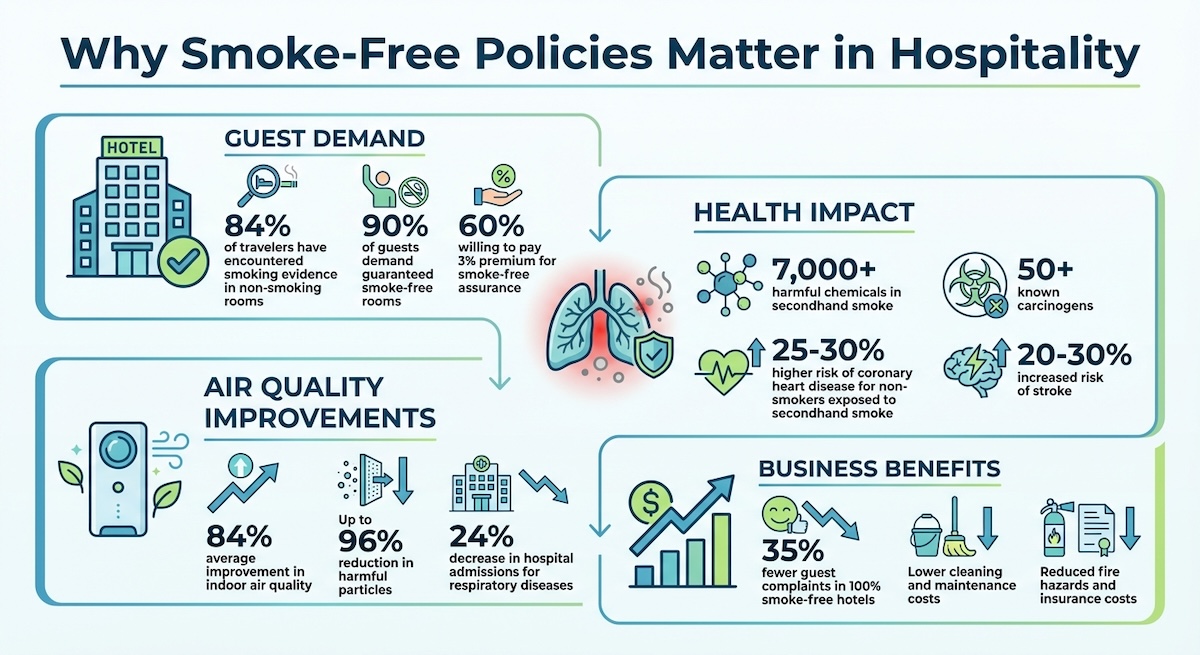
Beyond unpleasant odors, smoke exposure poses serious health risks. Secondhand smoke contains over 7,000 chemicals, including more than 50 known carcinogens [7][11]. Even brief exposure can cause immediate symptoms like eye and throat irritation, coughing, and shortness of breath [9].
For certain guests, the risks are even more severe. People with heart disease, asthma, or other respiratory conditions are especially vulnerable, facing a much higher likelihood of acute health problems from even minimal exposure [10]. The statistics are alarming: non-smokers exposed to secondhand smoke have a 25–30% higher risk of coronary heart disease and a 20–30% increased risk of stroke [10].
The effects of exposure occur quickly. Within just 60 minutes, secondhand smoke can cause inflammation and respiratory issues, with these effects lasting for hours [10]. It also damages blood vessels and increases the risk of heart attacks by making blood platelets stickier [10].
"There is no safe level of exposure to secondhand smoke. People who do not smoke but who are exposed to secondhand smoke, even for a short time, can suffer harmful health effects." - CDC [10]
Smoking in hospitality settings brings another serious risk: fire hazards. Guests who disregard smoke-free policies put everyone at risk [12].
When Marriott Hotels adopted a 100% smoke-free policy across all North American properties in 2006, fire safety was a major motivator. As the American Nonsmokers' Rights Foundation noted, "This move has been good for health and good for business with benefits such as reduced cleaning costs and fire hazards" [1].
The financial benefits are clear. Smoke-free policies lower renovation and insurance costs by preventing cigarette-related damage to furnishings and structures [4][1]. This not only reduces immediate fire risks but also minimizes the long-term expenses tied to smoking-related repairs and replacements.
Smoke-free policies bring immediate, measurable health benefits for both guests and staff. By removing smoke from the equation, hotels not only safeguard health but also create a more welcoming and comfortable environment. The positive effects begin almost instantly and continue throughout a guest's stay, ensuring everyone can breathe easier.
Banning smoking in hotels has a profound impact on air quality. On average, indoor air quality improves by 84%, with some properties seeing up to a 96% reduction in harmful particles [3]. This translates to noticeable health benefits for both guests and employees.
For example, when Michigan enacted the Dr. Ron Davis Smoke-Free Air Law in May 2010, nonsmoking bar employees experienced dramatic changes within just two months. Their urine cotinine levels - an indicator of smoke exposure - dropped from 35.9 ng/ml to undetectable levels. Alongside this, employees reported significantly fewer respiratory symptoms [13].
The benefits extend beyond immediate effects. Comprehensive smoke-free laws have been associated with a 24% decrease in hospital admissions for respiratory diseases [9]. For guests with chronic conditions like COPD, the results are even more striking, with an 11% reduction in hospital admission rates among Medicare beneficiaries aged 65 and older [9].
"There is no risk-free level of secondhand smoke, and even brief exposure can cause immediate harm." - U.S. Surgeon General [13]
Unlike ventilation systems that merely circulate air, complete smoking bans address the root cause. Studies confirm that ventilation and air-cleaning systems cannot fully eliminate the health risks of secondhand smoke - only total bans can [4].
For travelers with allergies or sensitivities, smoke-free properties offer a noticeable improvement. These policies remove a major source of irritation, reducing symptoms like eye discomfort, throat irritation, runny noses, and nasal congestion [9]. For those with asthma, the difference is even more critical, as smoke exposure poses constant risks.
The evidence is clear. After Scotland implemented a national smoke-free law in 2006, hospital admissions for childhood asthma dropped by 18.2% annually [9]. Similarly, England saw an 8.9% reduction in emergency hospital admissions for children with asthma following its smoke-free legislation [9].
In another case, the Colorado Public Housing Authority banned smoking in three buildings in December 2013. By March 2015, a study of 115 residents revealed significant decreases in breathing problems, asthma attacks, eye irritation, nasal congestion, and ear or sinus infections [15].
Modern smoke-free policies are evolving to include e-cigarettes and marijuana, as these also release harmful chemicals similar to traditional tobacco [8][14]. This comprehensive approach ensures that all guests, regardless of sensitivities, can enjoy a worry-free stay, whether they deal with asthma, allergies, or chemical sensitivities. These improvements in air quality further enhance guest comfort, creating a healthier and more pleasant environment for everyone.
Smoke-free policies don’t just benefit health - they also lead to noticeable improvements in the indoor environment. Cleaner air, fresher surfaces, and smoother property operations are just a few of the measurable, long-lasting changes.
One of the first things people notice in smoke-free spaces is the absence of stale smoke odors. This isn’t about covering up smells - it’s about stopping them at the source. By eliminating indoor smoking, properties prevent toxic thirdhand smoke residues from settling on surfaces. These residues not only create persistent odors but also pose long-term health risks.
Take New York, for example. In July 2003, the state introduced a smoke-free law for hospitality venues. Researchers MJ Travers and KM Cummings from the Roswell Park Cancer Institute studied 20 venues in Western New York from July to November 2003. Their findings were striking: levels of respirable suspended particles (RSPs) plummeted from 324 µg/m³ to 25 µg/m³ - a staggering 84% reduction - immediately after the law took effect [7]. Even spaces with indirect exposure, like restaurants next to smoking-allowed bars, saw a 58% drop in particulate matter once the entire building adopted smoke-free policies [7]. Cleaner air doesn’t just enhance guest comfort - it also reduces strain on building systems.
Smoke-free policies also protect the mechanical systems that keep indoor spaces comfortable. HVAC systems are designed to circulate air, but they can also spread smoke particles throughout a building. The CDC highlights this risk:
"The operation of a heating, ventilating, and air conditioning system can distribute secondhand smoke throughout a building" [4].
When smoking is removed from the equation, HVAC systems no longer circulate smoke through vents and ductwork. This leads to cleaner filters, fewer replacements, and lower maintenance costs. Properties also avoid the expense of deep-cleaning fabrics, repainting walls stained by smoke, and replacing air filters clogged with tobacco particles [4][8].
Marriott International is a prime example of the benefits of going smoke-free. In September 2006, the company implemented a 100% smoke-free policy across its North American hotels - over 2,300 properties and 400,000 rooms. The move not only created a healthier space for guests and staff but also reduced cleaning costs and minimized fire hazards. By 2021, Marriott celebrated 15 years of maintaining this policy as a standard for guest comfort and operational efficiency [1]. Cleaner air and fewer maintenance disruptions translate directly into a better experience for everyone.
Creating smoke-free environments isn't just about health benefits - it’s also a powerful way to build guest loyalty. Travelers value clean air, and hotels that prioritize this stand out in a competitive market.
Today's travelers are more health-conscious than ever. They seek more than just a comfortable bed - they want spaces that align with their wellness priorities. Indoor air quality has become a key factor in choosing accommodations, ranking alongside amenities like scenic views or luxurious bedding. Smoke-free policies directly cater to this growing demand.
The numbers back this up: 95% of travelers prefer hotels that guarantee rooms free from prior smoking incidents [2]. Yet, 84% have encountered signs of smoking in so-called "non-smoking" rooms [2]. This disconnect between guest expectations and reality is driving loyalty toward properties with strict smoke-free policies. In fact, 60% of travelers are willing to pay a 3% premium for the assurance of a genuinely smoke-free room [2].
By meeting these expectations, hotels can leave a lasting impression on guests. Clean air policies not only attract health-conscious travelers but also lead to glowing reviews and increased repeat bookings.
Smoke-free environments translate directly into guest satisfaction. Marriott International’s decision to implement a 100% smoke-free policy across its North American properties in 2006 was a response to guest feedback. As their Senior Vice President of Public Relations put it:
"The majority of the guests wanted a non-smoking guest room. ... You want your guests to be happy in this business" [5].
The results speak for themselves. By 2019, Marriott reported one of the lowest smoke-related complaint rates in the industry - just 0.94 per 100 reviews [6]. In contrast, hotels with designated smoking rooms experienced 35% more guest complaints [6]. Interestingly, 80% of tobacco-related complaints stemmed from stale odors caused by thirdhand smoke residue rather than active smoking [6]. Guests can sense the difference, and it influences their future booking decisions.
The financial impact of clean air policies is also clear. In April 2025, FreshAir Sensor launched its "FreshAir Certified" program, enrolling over 15,000 hotel rooms within weeks. Participating hotels saw a revenue boost of $2,500 to $5,000 per month per promotion channel by marketing certified smoke-free rooms as a premium option [2]. Guests are not only willing to pay for this assurance - they return for it and recommend it to others. Clean air is more than a perk; it’s a loyalty driver.
A Little Inn on Pleasant Bay goes the extra mile to prioritize guest comfort by maintaining a completely smoke-free environment. Across its nine uniquely designed rooms and common areas, this policy ensures that every corner of the property remains fresh and inviting. By keeping nicotine residue at bay, the inn protects its premium linens, elegant furnishings, and spa bathrooms from the wear and tear smoking can cause [5][12].
This smoke-free approach elevates the guest experience in every way. Rooms are filled with the crisp scent of ocean breezes, untainted by lingering tobacco odors. Guests can relax knowing the luxurious linens and spa-like bathrooms remain in pristine condition. Whether enjoying a European-inspired breakfast or unwinding on the private dock, visitors can breathe easy, knowing the air quality matches the inn’s high standards of luxury and care.
At its core, the inn’s management believes that a clean, odor-free environment is vital to creating a relaxing and rejuvenating stay. This philosophy aligns perfectly with the serene atmosphere that travelers seek when choosing a boutique bed and breakfast.
The smoke-free policy not only ensures consistently fresh air but also reflects the inn’s dedication to guest well-being [1][6]. Paired with thoughtful amenities like concierge services and beach access, this commitment to air quality creates a seamless luxury experience. Every detail, no matter how small, is designed to support guest comfort and provide a tranquil escape.
Smoke-free policies play a key role in creating a comfortable, healthier, and more enjoyable guest experience. These policies offer measurable benefits, including an 84% reduction in harmful airborne particles in hospitality settings, ensuring cleaner air for everyone [3][7]. Additionally, properties that adopt 100% smoke-free policies report a noticeable drop in guest complaints [6]. These improvements directly translate to better air quality, enhanced comfort, and peace of mind for visitors.
The health benefits are undeniable. Guests are shielded from exposure to over 50 carcinogens found in secondhand smoke, while also avoiding the unpleasant odors and residues that smoking leaves behind on furniture, drapes, and carpets [7][1]. This is particularly important for travelers with respiratory sensitivities or families who prioritize a genuinely clean and safe environment.
Take A Little Inn on Pleasant Bay as an example. Their commitment to a smoke-free policy ensures pristine air quality throughout all nine uniquely designed rooms and common areas. This not only preserves the inn’s premium furnishings and linens but also creates the fresh, welcoming atmosphere that health-conscious travelers expect from a boutique stay.
This trend reflects a broader movement within the hospitality industry, where 100% non-smoking buildings are becoming the norm rather than the exception [6][1]. When paired with amenities like spa-inspired bathrooms, concierge services, and waterfront views, a smoke-free environment becomes a key element of a seamless luxury experience. By prioritizing guest well-being and comfort, smoke-free policies have become a cornerstone of guest satisfaction in modern hospitality.
Thirdhand smoke is the leftover toxic residue from tobacco smoke that sticks to indoor surfaces such as furniture, walls, and carpets. This residue contains harmful chemicals like nicotine and carcinogens, which can remain for months. These substances can pose health risks through skin contact or by being inhaled.
Smoke-free policies contribute to better sleep by cutting down exposure to secondhand smoke, a known disruptor of sleep patterns. Secondhand smoke can make it harder to fall asleep or stay asleep, particularly for non-smokers who are more sensitive to its effects. By maintaining smoke-free environments, hospitality spaces ensure cleaner air and a more restful experience, offering guests a healthier and more relaxing atmosphere to unwind.
Hotels maintain smoke-free environments by combining clear communication, visible signage, staff training, and consistent monitoring. Prominent "No Smoking" signs are displayed throughout the property, and staff make sure to inform guests about the policy during check-in. Additionally, details about the rules are often included in booking confirmations to ensure guests are aware before arrival. If a guest violates the policy, consequences may include fines, cleaning fees, or even being asked to leave the premises. These efforts help create a healthier atmosphere, improve air quality, and contribute to a more enjoyable experience for all guests.
If you're looking for a peaceful and personal Cape Cod experience, now's the time to book your stay at A Little Inn on Pleasant Bay. With its quiet setting, friendly hosts, and small seasonal touches that make a big difference, it’s a great place to relax and enjoy the best bed and breakfast in Cape Cod. Whether you’re planning a weekend getaway or a longer break, don’t wait too long—anytime is the best time to visit, and rooms fill up fast.


