We are open May 6th - October 8th 2022. Please book directly with us via our website! We look forward to welcoming you at our beautiful place on Cape Cod.

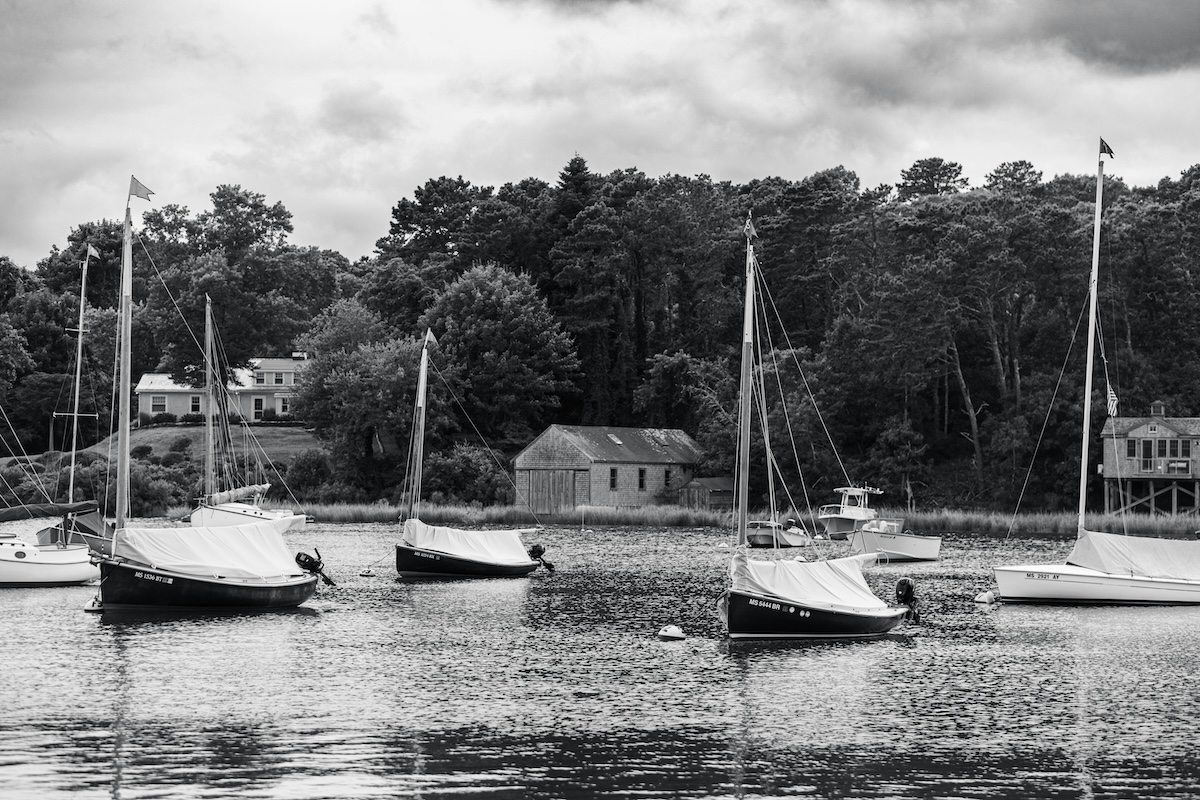
Cape Cod’s connection to sailing runs deep, shaped by its history, geography, and evolving industries. From its origins as a hub for fishing and whaling to becoming a destination for recreational sailing, the region’s maritime legacy is rich and enduring. Here’s what you need to know:
Cape Cod’s sailing traditions continue to thrive, blending historical roots with modern-day activities, ensuring its maritime identity endures for future generations.
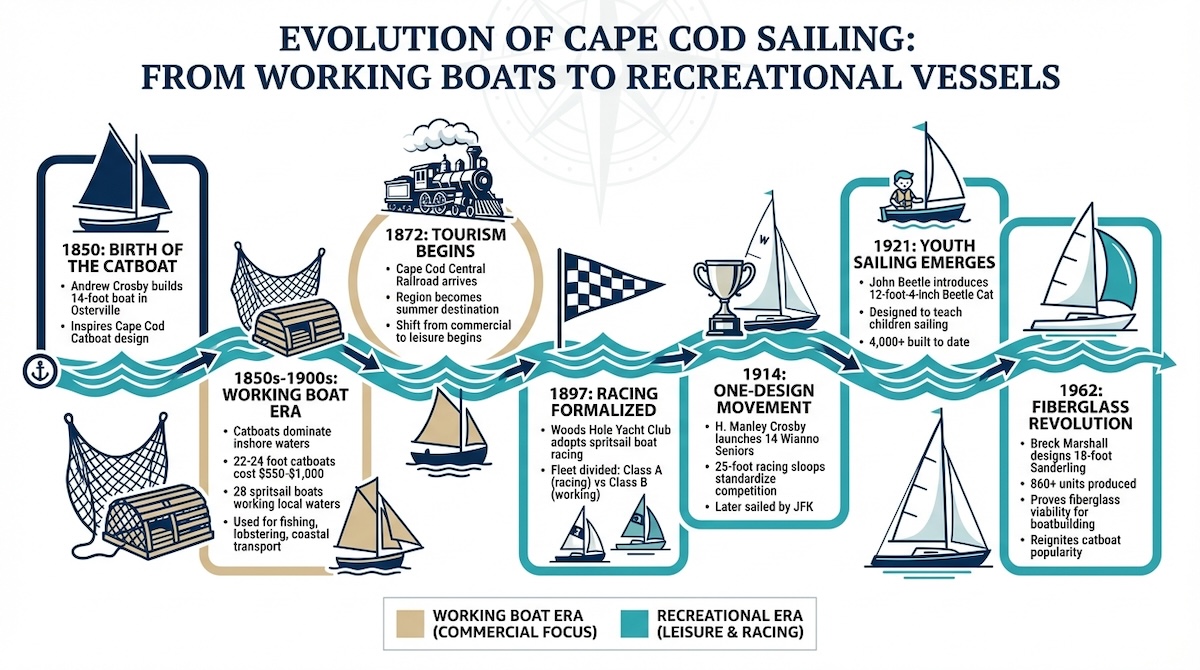
In the mid-19th century, Cape Cod's working boats were all about practicality and survival. Around 1850, Andrew Crosby, a ship's carpenter, and his sons Worthington and Horace built a 14-foot boat in Osterville. This boat, with its plumb stem and square transom, handled the rough waters of Chatham Bar so well that it inspired the creation of the Cape Cod Catboat [8][9].
Catboats became a staple in the region's inshore waters from the 1850s through the early 1900s. These boats were essential for fishing, lobstering, and coastal transport. Their standout feature? A wide beam nearly half the hull's length, which earned them the nickname "the stability of a dinner plate" [8][12]. Fenwick Williams explained that the broad beam allowed for stone ballast, while the high bow and side decks provided both structural support for the mast and practical space for lobster traps [6].
On the other hand, the Woods Hole spritsail boat served a more specialized role. These smaller wooden boats, typically 12 to 14 feet long, were used for handlining finfish, trapping lobsters, and digging for shellfish in Buzzards Bay and Vineyard Sound [5]. The defining feature of these boats was their four-sided sail, supported by a diagonal spar known as a sprit. They also had a clever "mast partner" gate, which allowed the mast to be quickly lowered to pass under fixed bridges, like those at Eel Pond [5]. At their peak, as many as 28 spritsail boats worked the local waters, though only six originals remain today [5].
A key advantage of both designs was their ability to be operated by just one person. As columnist Lawrence Brown put it:
"For a fisherman or lobsterman, this meant a catboat could be left to tend to itself - sails up - while the owner worked his nets and traps. One man could do it" [8].
In the late 19th century, a typical 22- to 24-foot catboat cost between $550 and $1,000, making it affordable for working-class fishermen. For comparison, large yachts of the time could cost $5,000 or more [7]. The ability to operate these boats solo not only made them efficient but also laid the groundwork for their eventual transformation from workhorses to recreational vessels.
As the economy and technology evolved, these practical workboats found a new purpose in leisure. The arrival of the Cape Cod Central Railroad in 1872 turned the region into a summer hotspot for tourists, while advances like gasoline engines and outboard motors made sails less critical for commercial work [5][6].
With these changes, working boats transitioned into the leisure market. By 1897, the Woods Hole Yacht Club had adopted the spritsail boat as a primary racing class, dividing the fleet into "Class A" (racing) and "Class B" (working) boats [5]. This shift mirrored a broader trend where leisure activities began to replace industrial practices. Boats that once hauled fish or delivered mail were now competing for trophies and cash prizes.
The one-design movement further pushed this transformation by standardizing boat specifications. This ensured that races tested sailors' skills rather than their wealth or the sophistication of their boats [5][11]. In 1914, H. Manley Crosby of the Crosby Yacht Yard in Osterville launched the first fleet of 14 Wianno Seniors - 25-foot racing sloops commissioned by the Wianno Yacht Club. These boats eliminated the need for complex handicap systems and gained international recognition, especially when John F. Kennedy frequently sailed them [11].
In 1921, John Beetle of New Bedford introduced the 12-foot-4-inch Beetle Cat as a one-design class to teach children how to sail [6][8]. Over 4,000 Beetle Cats have been built, making them a fixture in New England harbors [10]. Later, in 1962, Breck Marshall of Marshall Marine designed the 18-foot fiberglass Sanderling, inspired by traditional wooden catboats. With over 860 units produced, the Sanderling proved that fiberglass was a viable material for boatbuilding and reignited interest in catboats for recreational use [6][10].
Cape Cod's Figawi Race is a highlight of the summer season, kicking off every Memorial Day weekend. Its 55th edition is set for May 22–25, 2026. This pursuit-style race, which began in 1972, spans 25–30 miles from Hyannis Port Jetty to Nantucket Boat Basin. It draws 200–240 boats and approximately 3,000 participants across 13 classes. The race operates under the Performance Handicap Racing Fleet (PHRF) system, with boats launching at staggered times between 10:00 a.m. and noon. Spectators can enjoy the start at Kalmus Beach in Hyannis or catch the thrilling finish at Nantucket Harbor's entrance.
The weekend offers more than just the main event. Sunday features the Figawi Invitational, where high school teams from Cape Cod and the Islands compete in double-handed 420 boats. On Monday, the "Redux" Race brings participants back from Nantucket to the mainland. Each boat receives three of the iconic red Figawi hats, a cherished tradition. Beyond the races, the event has a strong philanthropic side, raising nearly $2 million for local organizations like the Hyannis Youth and Community Center, Cape Cod Hospital, and the Boys and Girls Club. The annual Charity Ball alone contributes around $200,000. Reflecting on the event's impact, Connie Horan, wife of co-founder Bob Horan, shared:
"If there's one thing my husband would be proudest of, it's the good work that has come from this race." [14] [15] [16] [17]
While the races bring excitement, the community’s commitment to preserving Cape Cod’s maritime heritage is equally notable.
Cape Cod’s dedication to its maritime roots is evident through institutions like the Cape Cod Maritime Museum in Hyannis. This museum showcases the region’s seafaring history with interactive exhibits such as "Catboats: The Boat with 9 Lives" and "Historic Watercraft of Cape Cod." It also offers traditional boat-building programs and educational lectures. A standout attraction is the historic catboat Sarah, which provides public sailing experiences.
The museum’s initiatives, like the Young Mariner Program and the "History on Tap" lecture series, ensure maritime traditions are passed down. Topics have ranged from the 1952 SS Pendleton rescue to tales of women pirates. In February 2026, local historian Reid Oslin presented "The Coast Guard's Greatest Small Boat Rescue," bringing legendary maritime stories to life.
The museum operates year-round, with admission priced at $10 for adults, $8 for seniors and veterans, $5 for students aged 6–17, and free for active-duty military, first responders, and children under 6. Additionally, Figawi Charities Inc. supports young sailors through its Youth Sailing Initiative, with proceeds also benefiting local veterans and first responders. These efforts ensure Cape Cod’s rich sailing traditions continue to thrive for future generations. [3] [13]
Cape Cod's rich maritime history comes alive through hands-on sailing experiences in Pleasant Bay, where visitors can enjoy modern comforts while connecting with age-old sailing traditions.

Staying at A Little Inn on Pleasant Bay offers more than just cozy accommodations. Guests have access to a private dock and pebble beach, perfect for swimming, kayaking, fishing, and, of course, sailing. If you're arriving by boat, mooring is available too.
The inn's waterfront patio, complete with Adirondack chairs, provides a front-row seat to local sailing regattas. For those eager to hit the water, the concierge can arrange activities and connect guests with nearby sailing schools for lessons or guided excursions.
Pleasant Bay Community Boating (PBCB), based in Harwich, boasts an impressive 3.75-acre waterfront facility and a fleet of over 80 boats. Their programs cater to every skill level, offering more than 500 sailing experiences in 2025 alone. For 2026, registration opens on February 24 at 10:00 a.m. for "Women on the Water" sessions, with all other adult programs opening the following day at the same time. Beyond sailing, PBCB runs a "Floating Classroom" for marine science education, organizes affordable Council on Aging trips for seniors that include basic sailing lessons, and hosts a free open house each July, where people of all ages can experience sailing firsthand [18][20][21].
Arey's Pond Sailing School, a fixture on Little Pleasant Bay since 1964, focuses on teaching sailing aboard classic Cape Cod catboats. These gaff-rigged boats are stable and beginner-friendly, making them ideal for sailors of all levels. Private two-hour catboat lessons cost $175, with an additional $25 fee per extra student beyond three. Rentals are also available: $150 for two hours or $240 for four hours for 14′ boats, and $180 for two hours or $270 for four hours for 16′ boats [19].
Cape Cod's sailing tradition is a story of transformation, weaving together its rugged maritime past and vibrant present. Every harbor and stretch of coastline carries echoes of maritime legends, reflecting the region's deep-rooted connection to the sea. At its peak, Cape Cod's waterways were among the busiest globally, second only to the English Channel in marine traffic [1][4]. Today, a passionate sailing community keeps this bond alive.
The area's treacherous shoals and dense fog - earning it the ominous title "Graveyard of the Atlantic" - shaped a culture of exceptional seamanship and resilience [4]. This legacy is honored not just in historical accounts but also in hands-on traditions. Programs like those teaching teenagers to build Bevin’s Skiffs from white oak and cedar, or sunset cruises accompanied by sea shanties, ensure these skills and stories are passed down [2].
Whether you're relaxing on the private dock at A Little Inn on Pleasant Bay, taking lessons at a local sailing school, or simply admiring the white sails dotting the horizon from an Adirondack chair, you're part of a centuries-old tradition. As Elizabeth York, Executive Director of the Cape Cod Maritime Museum, so aptly puts it:
"It's a connection to where we came from and what sets us apart. That's got to be worth preserving." [2]
With 600 miles of shoreline and 14 historic lighthouses, Cape Cod offers a warm welcome to sailors of all skill levels [23]. The prime sailing season, spanning May through September [22], provides endless opportunities to experience the magic of these storied waters.
Cape Cod is often referred to as the 'Graveyard of the Atlantic' - a name that speaks to its perilous waters. The region's shifting shoals and sandbars have been the cause of over 3,000 shipwrecks in just 300 years. Many of these tragedies occurred during fierce nor’easters and violent storms, cementing Cape Cod's reputation as a hotspot for maritime disasters.
Catboats and spritsail boats are perfect for solo sailing, thanks to their straightforward design. With just one sail and a mast positioned toward the front, they provide great stability and are easy to handle. These boats are designed to prioritize both simplicity and functionality, offering an enjoyable and hassle-free experience for individual sailors.
If you're new to sailing and want to explore Pleasant Bay, Pleasant Bay Community Boating (PBCB) is the perfect place to start. They offer lessons at a reasonable cost, led by seasoned instructors who focus on helping you build both skills and confidence on the water.
Beginners can dive into group classes or introductory courses tailored specifically for those just starting out. PBCB also has boat rentals and beginner-friendly sailing options, with a supportive team ready to assist you at every turn. It's a great way to ease into the world of sailing while enjoying the beauty of Pleasant Bay.
If you're looking for a peaceful and personal Cape Cod experience, now's the time to book your stay at A Little Inn on Pleasant Bay. With its quiet setting, friendly hosts, and small seasonal touches that make a big difference, it’s a great place to relax and enjoy the best bed and breakfast in Cape Cod. Whether you’re planning a weekend getaway or a longer break, don’t wait too long—anytime is the best time to visit, and rooms fill up fast.


