We are open May 6th - October 8th 2022. Please book directly with us via our website! We look forward to welcoming you at our beautiful place on Cape Cod.

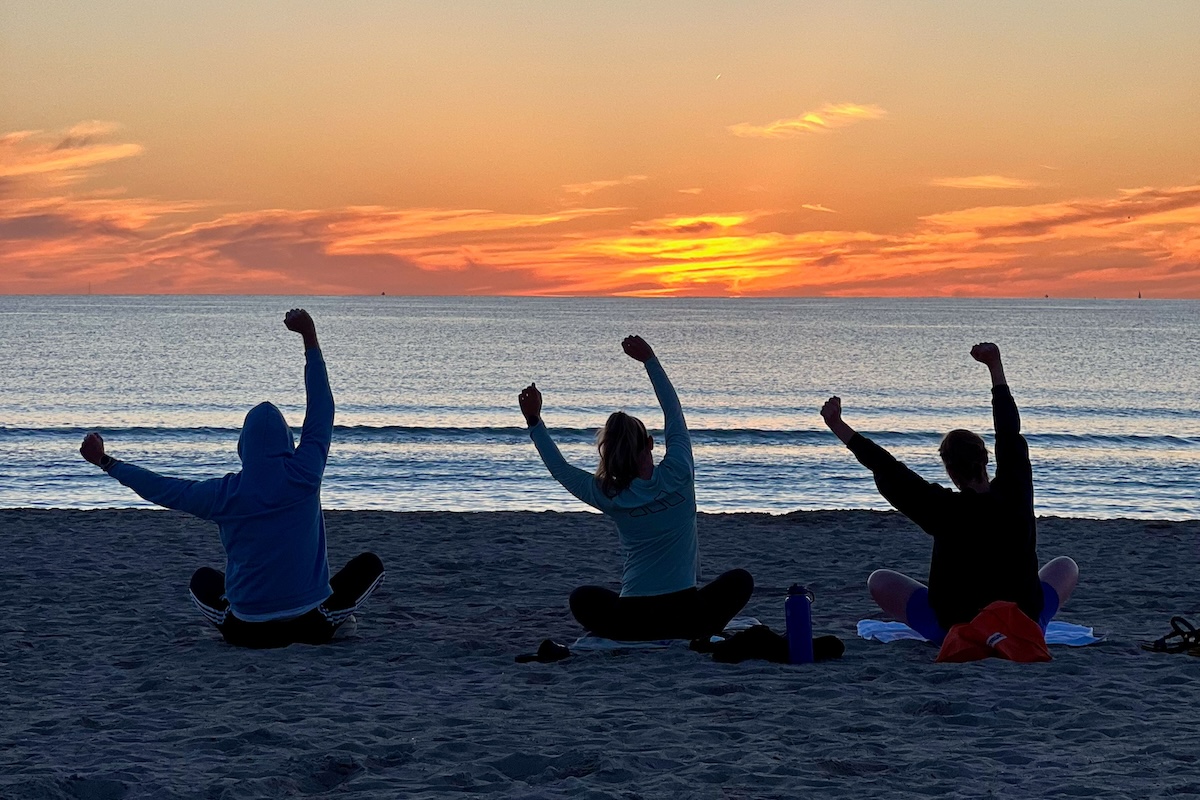
If you feel worn out, a quiet bay stay may help more than a packed retreat. I’d sum it up this way: Cape Cod’s bay side helps by cutting noise, screens, and schedule pressure. In as little as 2 to 3 days, many travelers can feel less mental drag, sleep better, and think more clearly.
Here’s the short version:
I see the main point like this: the best reset is often less, not more. A place like A Little Inn on Pleasant Bay fits that idea with no TVs, bay views, a private dock, and an easy pace that does not ask you to perform.
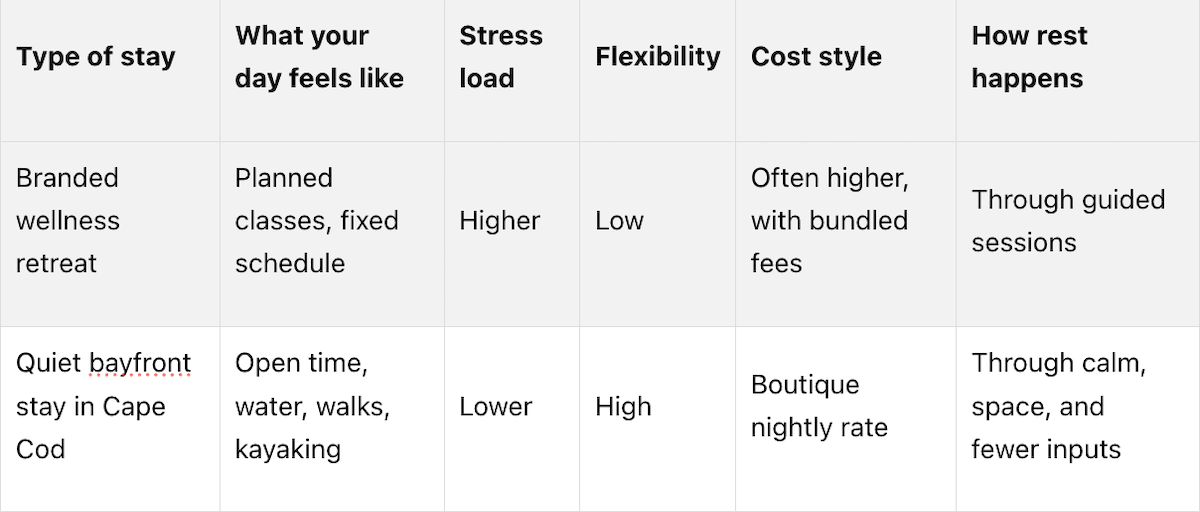
My takeaway: if you want a relaxing getaway in Cape Cod, the bay side stands out not because it gives you more to do, but because it gives you less to manage.
A lot of vacations miss the mark for one simple reason: they keep your brain working the same way it does at home. Crowded spots, jam-packed plans, and noisy settings all demand the same watchfulness as a long workday. So the place itself often matters more than the itinerary.
Your brain uses two kinds of attention. Effortful focus is what you rely on to get around an unfamiliar city or stay on top of a travel schedule. It has limits, and it wears down. [1] Effortless attention is different. That’s the kind that takes over when you watch clouds drift over the water. It doesn’t drain you.
Here’s where many vacations go sideways: they lean too hard on the first kind. Even screens add to the problem. Scrolling social media or watching TV keeps your mind lightly switched on instead of letting it rest. [1] The result is familiar: mental fog, irritability, and that annoying sense that you need a vacation from your vacation.
The research lines up with what many people feel. Stress hormone levels start to drop within 20 to 30 minutes in nature. [1] A 50-minute walk in a natural setting can improve working memory and attentional performance compared with the same walk in busy, built-up places. The change isn’t from the exercise itself. It comes from the setting. [1]
Natural places give your mind gentle things to settle on, like water, clouds, and wide horizon views. Those cues hold attention without asking much from you. [1][2] Busy, built-up places do the reverse. Noise, crowds, and unpredictability keep the nervous system on edge. If a vacation just moves you into a new place with the same level of stimulation, the pattern stays the same. Only the backdrop changes.
Cape Cod by the bay works because it cuts down stimulation without asking your brain to work for it.
Cape Cod by the bay turns that idea into something you can feel: water, light, quiet, and easy movement working together to slow things down.
Water gives the mind a soft place to land. The motion, the light, the shifting color - it holds your attention without asking anything from you. That kind of gentle focus sits at the center of how nature helps the brain recover.[1][2]
Coastal places are linked to better mental well-being and lower stress. In one study of 26,000 adults, people living within 1 km of the coast reported better mental health than those living 50 km inland.[3] A bay setting like Pleasant Bay has its own edge here: the open horizon. Instead of your view stopping at a line of trees, the eye gets space. And that space gives the mind room to loosen its grip.
That same sense of ease carries into the first light of the day over the bay.
One of the quieter parts of a bayside stay is the light itself. Morning sun over the water helps reset the sleep-wake rhythm and steady mood. Even during a short trip, that daily dose of natural light can start to shift the pace of the day.
The tide adds another layer. Its steady in-and-out pattern brings a calm kind of repetition, without pressure or noise. That low-threat sensory setting supports the body's rest-and-digest mode.[2][3] You don't have to plan for it or work at it. You just have to be there.
Once the mind has less to sort through, gentle movement starts to feel less like effort and more like recovery.
There's a big difference between a workout and moving through nature at an easy pace. A 50-minute walk in nature is enough to bring attention back to baseline, and the gain comes from the setting, not how hard you push.[1] The same idea applies to kayaking across a calm bay at your own speed.
These activities help because they give the body something light to do while letting the mind drift a bit. And that drifting matters. It's the kind of mental recovery that happens when you're no longer pinned to a screen, a clock, or a packed plan. At A Little Inn on Pleasant Bay, bay views, a private dock, and no televisions make that low-stimulation rhythm easy to settle into. For many people, a couple of days at that pace is enough to feel the shift.
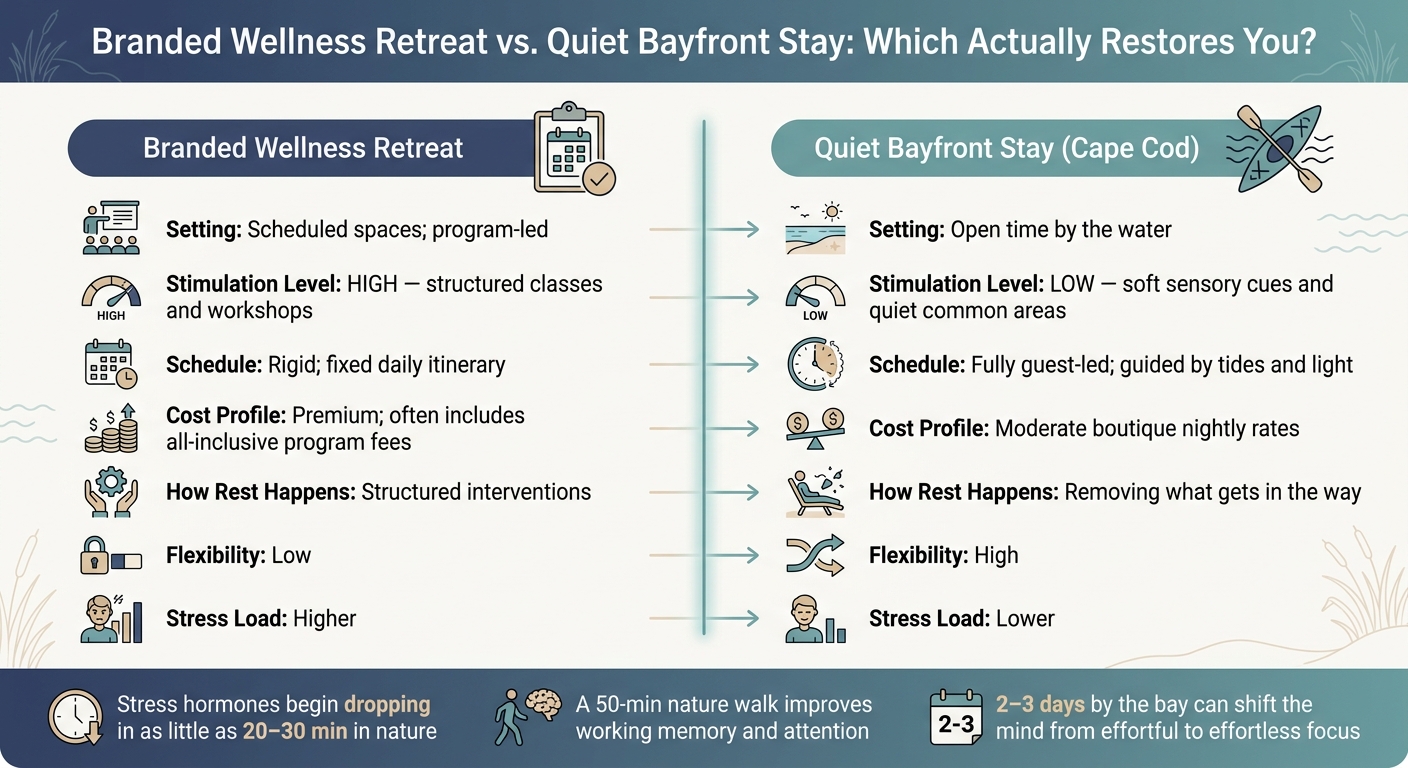
Once the first day starts to slow, the bay begins to do some of the heavy lifting.
At first, your mind is often still moving at its normal clip: checking, planning, staying one step ahead. The change usually begins on that first evening. You spend an hour by the bay, watching the light move across the water, with no plan and nowhere to be. That simple pause matters. By the second night, sleep often gets better as screens drop out of the picture and the setting stays calm.
By day three, some of that mental clutter starts to fall away. Research on blue space connects short, repeated visits with better mood and lower stress.[2] A 48- to 72-hour stay can be enough to shift you out of effortful focus - the kind used for work, tasks, and screens - and into effortless attention, the quieter state that comes from watching water move or a horizon stay still.[2][4]
By the second morning, the goal isn't to pack in more. It's to let more go.

That slower rhythm works best in a place that stays quiet on purpose. A Little Inn on Pleasant Bay sits on Pleasant Bay between Chatham and Orleans, in a 1798 cedar-shingled main house with nine rooms and no televisions anywhere on the property. It feels less like a program and more like space to breathe.
Mornings begin with a European-style breakfast served at an easy pace on a bay-facing patio. The spread includes Iggy's breads, smoked fish, specialty cheeses, cured meats, and homemade jams. No one is hurrying you along. And the water is there when you want it, not slotted into a timetable.
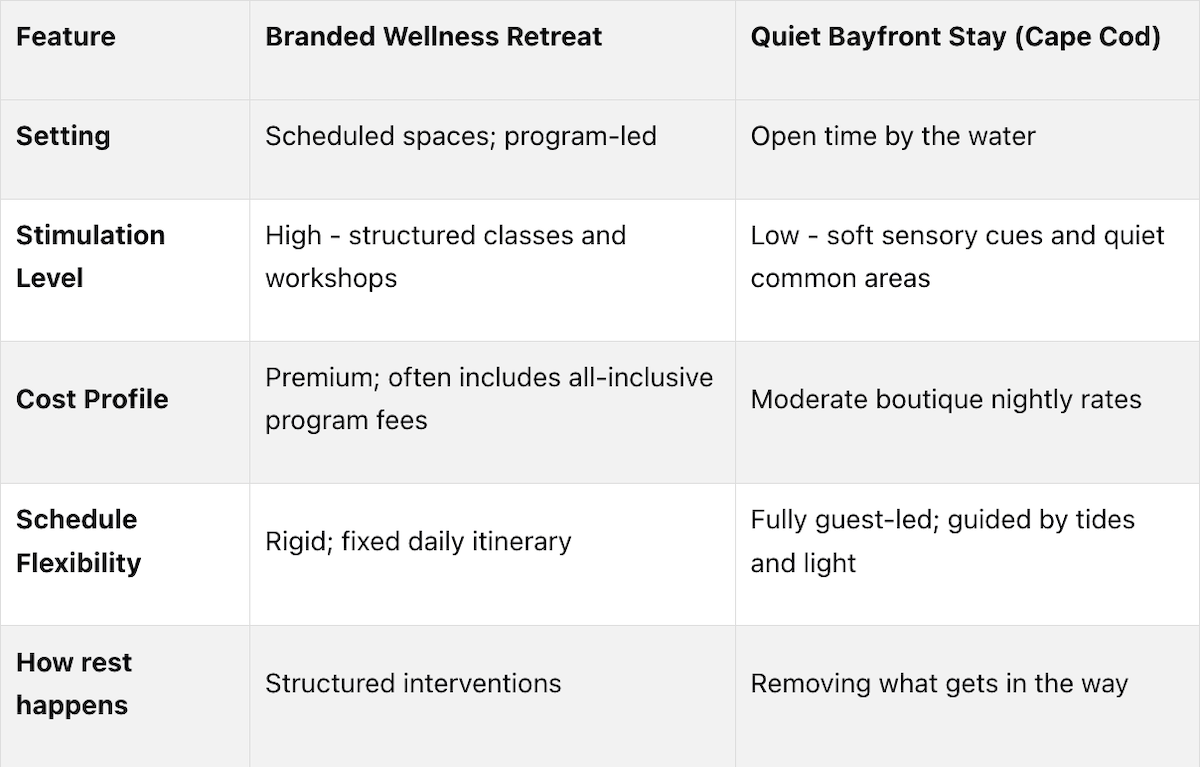
That's the appeal of a bay stay. Instead of telling you how to rest, it clears space for rest to happen on its own.
Cape Cod works as a wellness retreat Cape Cod travelers can trust because water, light, quiet, and easy movement give the mind room to recover without forcing a program. Sometimes that kind of reset doesn't need much. It just needs the right place and a little time.
In practice, that means choosing time and space over a packed itinerary. A 2- to 3-day stay by the bay can offer something many formal programs don't: the absence of demand. No schedule. No performance. No pressure. That break from daily life is what makes restoration possible. And the bay offers it without asking anything back.
A Little Inn on Pleasant Bay fits that idea well. With no televisions, kayak access from a private dock, and an unhurried pace, it creates a setting built for real recovery. That's the draw of a place like A Little Inn on Pleasant Bay.
The best retreat may be the one that simply gets out of the way.
Yes. Two to three days can be enough to start cognitive recovery and lower stress, especially in a natural, low-stimulation setting.
Research suggests that restoration depends not just on how long you stay, but on what surrounds you. Places like Pleasant Bay can help because natural light, tidal rhythms, and time outdoors give your mind space to reset.
At A Little Inn on Pleasant Bay, that short window is often just right for an unhurried disconnect.
Staying by the bay often feels calmer for a simple reason: low-stimulation natural settings can help the mind recover. Research on Attention Restoration Theory suggests that water creates “soft fascination,” holding your attention in a gentle way without the mental drain that comes with busy, high-stimulation places.
The result can be better mental clarity and lower stress. Private waterfront access, like at A Little Inn on Pleasant Bay, can add to that sense of ease by cutting down on crowds and taking pressure off rigid schedules.
Keep the focus on calm, low-stimulation activities that match the setting. At A Little Inn on Pleasant Bay, that could mean kayaking or paddleboarding from the private dock, settling into an Adirondack chair by the bay, or lingering in the gardens.
You can also borrow a bike and head out on the Cape Cod Rail Trail, or stop by nearby conservation areas for birdwatching and coastal walks. The idea is simple: keep the pace easy and let the light, water, and quiet set the tone.
If you're looking for a peaceful and personal Cape Cod experience, now's the time to book your stay at A Little Inn on Pleasant Bay. With its quiet setting, friendly hosts, and small seasonal touches that make a big difference, it’s a great place to relax and enjoy the best bed and breakfast in Cape Cod. Whether you’re planning a weekend getaway or a longer break, don’t wait too long—anytime is the best time to visit, and rooms fill up fast.


