We are open May 6th - October 8th 2022. Please book directly with us via our website! We look forward to welcoming you at our beautiful place on Cape Cod.

Wampanoag education programs focus on preserving the history, language, and practices of the Wampanoag people. These initiatives aim to reconnect tribal members with their heritage, instill values, and prepare future leaders. Key highlights include:
These programs ensure that Wampanoag traditions and knowledge are preserved and shared across generations and communities.
Several organizations are dedicated to preserving Wampanoag culture, language, and history through structured educational initiatives. While each group has its own focus, they all share a common mission: reinforcing Wampanoag identity for future generations. Here's a closer look at their roles and programs.
Based on Cape Cod, the Mashpee Wampanoag Tribe Education Department is at the forefront of cultural education in the area. Its aim is to nurture cultural awareness and identity among youth, blending traditional Wampanoag values with modern academics [2].
The department offers diverse programs, from early childhood education to environmental science camps. A notable initiative is the Native American Teacher Retention Initiative (NATRI), which supports Native educators in school districts like Mashpee, Falmouth, and Barnstable. Undergraduate students pursuing teaching degrees can receive up to $3,000 per semester in financial aid through NATRI. Additionally, Native teachers already working in classrooms can access a $750 stipend per semester for classroom-related expenses [9].
Located in Aquinnah on Martha's Vineyard, this department provides educational support for tribal members of all ages - from young children to adults [6]. It collaborates with groups like the Wôpanâak Language Reclamation Project to expand access to language and cultural programs for the Aquinnah community. Tribal members and their households can also participate in the Weetumuw School and other language immersion initiatives [8].
The WLRP plays a central role in reviving the Wôpanâak language. Its flagship program is the Weetumuw School, a language and culture immersion school for children aged 3–9. The school follows a Wampanoag version of the Montessori method and operates 180 days a year, from 8:15 a.m. to 3:15 p.m. [3]. The school's mission is summarized as:
"Weetumuw School prepares students... for academic excellence and community leadership by instilling traditional Wampanoag values through culture and language-based education for decolonization." [1]
WLRP programs collectively engage more than 1,000 members of the Wampanoag Nation, with 75% of participants belonging to the Mashpee Wampanoag Tribe [3].
Plimoth Patuxent Museums in Plymouth, Massachusetts, offer educational experiences on Wampanoag traditions through their Wampanoag Indigenous Program. This program features Wampanoag educators demonstrating traditional practices, including food preparation, tool-making, storytelling, and seasonal customs. Importantly, it is led entirely by Wampanoag individuals, providing visitors with an authentic perspective rooted in firsthand cultural knowledge.
Wampanoag education programs come in various forms, designed to connect with tribal families, students, and visitors eager to learn. These programs aim to preserve and share Wampanoag culture, language, and history. Let’s break down the key program types:
Some programs are integrated directly into the school system on Cape Cod. For instance, Mashpee High School offers a daily Wôpanâak language class, which fulfills the World Language credit requirement. This course, introduced in January 2018, is the first Native American language class in the area to count for high school credit [3]. Additionally, K.C. Coombs and Quashnet Elementary Schools provide weekly Wôpanâak language enrichment sessions as part of their regular curriculum [3].
Schools also have access to resources like the Speakers Bureau, which delivers presentations on topics such as tribal sovereignty, 12,000 years of Wampanoag heritage, Indigenous art, and climate resilience [7]. A traveling 10-panel exhibit on Mashpee Wampanoag Whalemen is available for schools and libraries, offering another educational resource [2]. High school juniors and seniors in the Cape Cod and Martha’s Vineyard area can also take part in Introduction to Indigenous Education (EDU102), a dual-enrollment college course worth three credits, offered at no cost [6].
Outside of these formal settings, early childhood programs introduce young learners to Wampanoag culture in immersive ways.
The Weetumuw School is a cornerstone of early childhood education, using the Wôpessori method to immerse children aged 3–9 in the Wôpanâak language every morning [8][10]. Each day begins with students reciting morning addresses in Wôpanâak, expressing gratitude for their ancestors and reaffirming tribal values [3]. The school’s teachers are all Wampanoag, and families are encouraged to join language classes and community events to support learning at home [8].
These programs extend learning beyond the classroom, ensuring that Wampanoag traditions are shared across the community. Neekun Camp, for example, offers a four-week summer program for Native American children aged 5–9. It combines STEM activities with Wôpanâak language lessons and cultural education, serving about 25 children per session [5]. During the school year, programs like Lunch Bunch at K.C. Coombs School and Daughters of Tradition at Quashnet Elementary provide additional cultural learning opportunities [2].
Museums and heritage sites offer hands-on ways to explore Wampanoag history and traditions. At the Felix Neck Wildlife Sanctuary on Martha’s Vineyard, seasonal programs link Wampanoag practices to nature, such as events centered around the herring run [2][6]. The Nantucket Historical Association also provides downloadable activity kits and lesson plans focused on Indigenous history, making it easier for educators and families to engage with Wampanoag heritage [6].
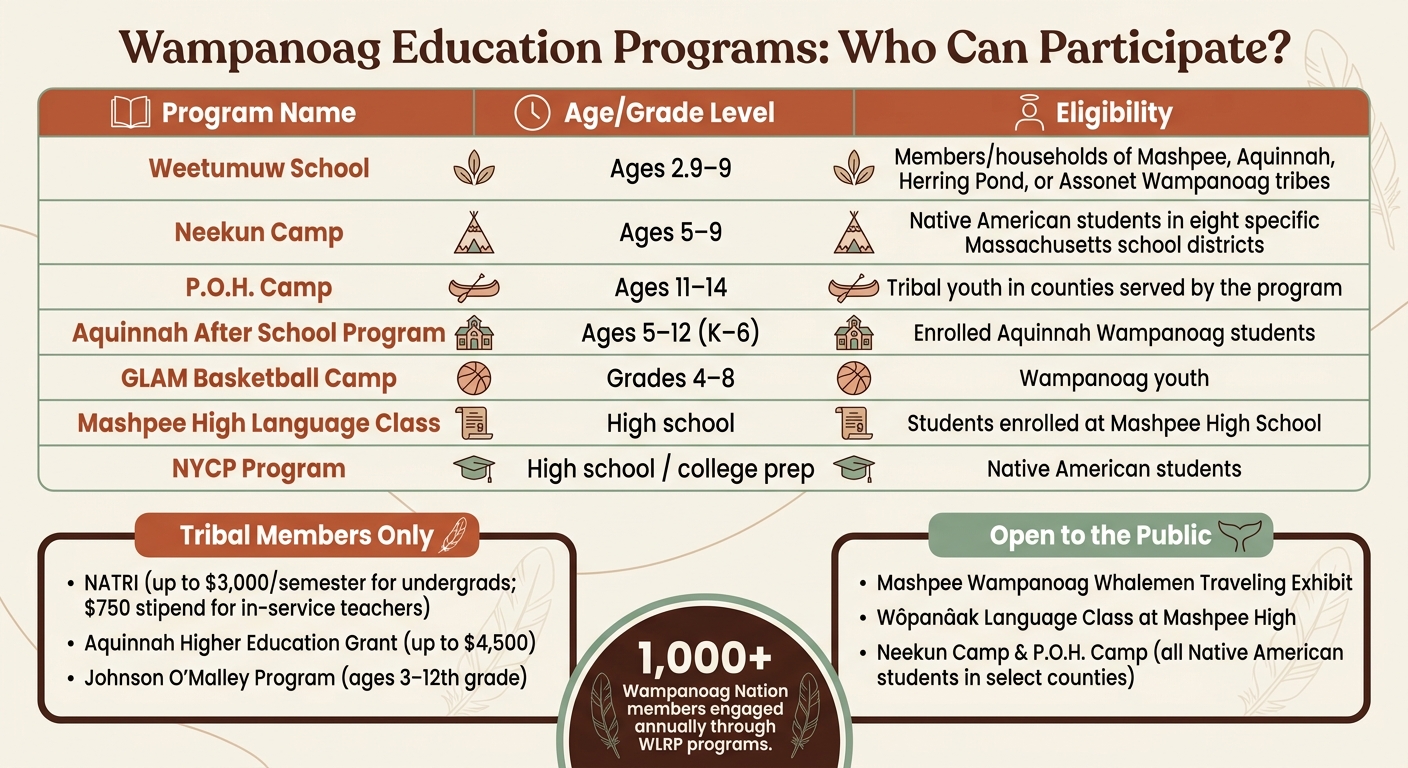
Eligibility criteria for these programs are tailored to meet various community needs, ensuring that resources are allocated effectively. While some initiatives are exclusively for tribal members, others welcome participation from the general public. Below, you'll find a detailed breakdown of eligibility requirements for tribal members, public programs, and specific age groups.
Certain programs are exclusively available to members of the Mashpee Wampanoag, Aquinnah Wampanoag, Herring Pond, or Assonet Wampanoag tribes. For instance, the Johnson O'Malley Education Program supports enrolled Mashpee Wampanoag children from ages 3 through 12th grade. Similarly, the Aquinnah Wampanoag Higher Education Grant offers financial aid of up to $4,500 for undergraduate and graduate students who are tribal citizens [6].
The Native American Teacher Retention Initiative (NATRI) is another program aimed at tribal members. It requires participants to be enrolled in a federally recognized tribe and commit to student teaching in Mashpee-serving districts. Undergraduate students can receive up to $3,000 per semester, while in-service teachers are eligible for a $750 stipend [9].
Several programs extend beyond tribal membership and are open to the public. For example, schools, libraries, and historical associations can host the Mashpee Wampanoag Whalemen traveling exhibit, a 10-panel display that explores the history of Wampanoag whaling [2]. Additionally, students at Mashpee High School, regardless of tribal affiliation, can take the Wôpanâak language class to earn World Language credit.
Summer camps like Neekun Camp and P.O.H. Camp are open to all Native American students living in Barnstable, Norfolk, Suffolk, Plymouth, and Bristol counties. These camps are not limited to Wampanoag tribal members [5].
"The Higher Education Grant Scholarship award was founded with the goal of providing Tribal Members with an equal opportunity to pursue a college education." - Wampanoag Tribe of Gay Head (Aquinnah) [6]
Programs cater to a wide range of ages, from toddlers to professionals, ensuring diverse needs are met. Here's a breakdown of the major programs and their target groups:
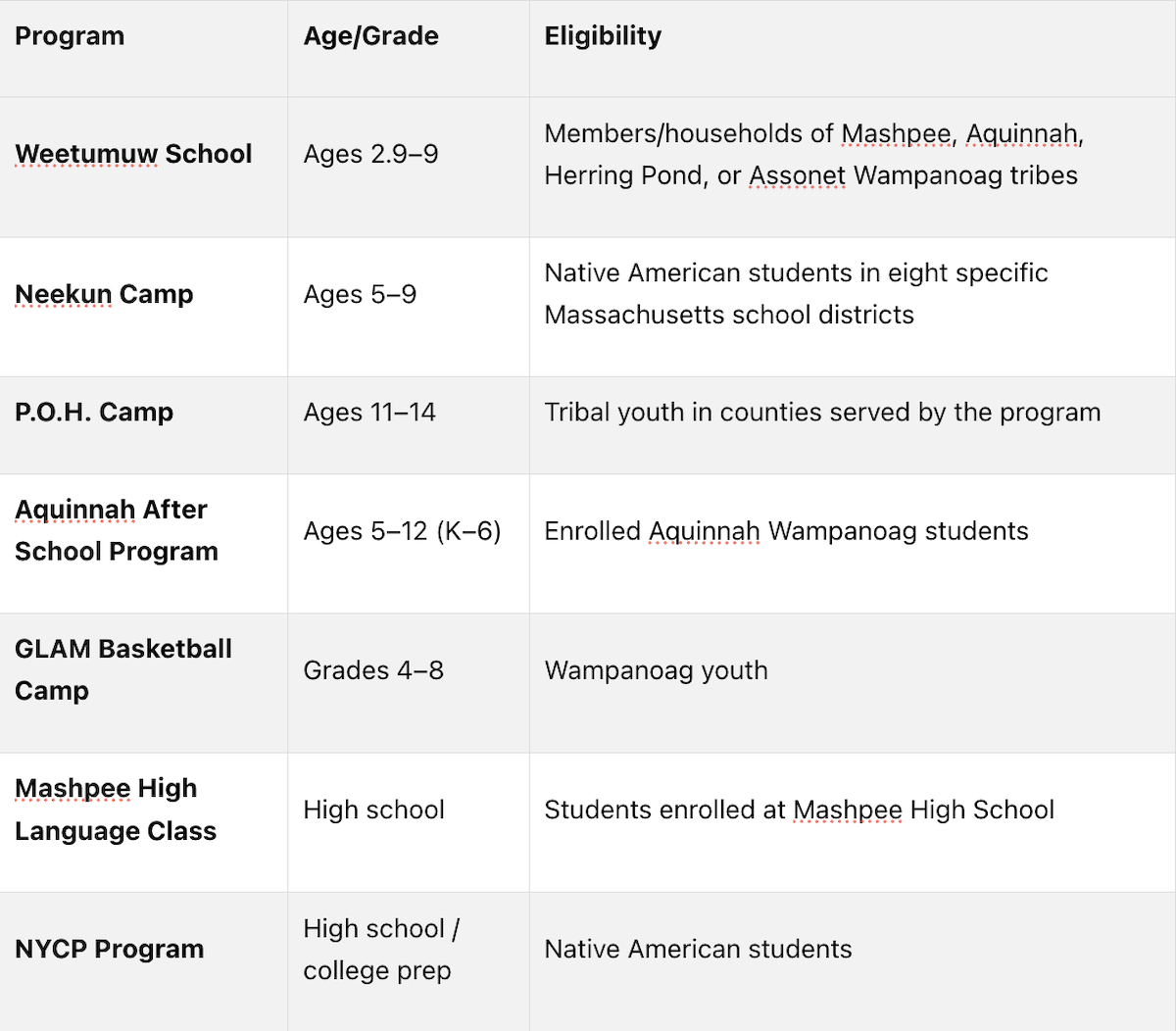
It’s important to note that some programs, like summer camps, have strict deadlines. For example, applications for Neekun Camp must be postmarked by June 9th and are processed on a first-come, first-served basis [5]. Early submission is highly recommended to secure a spot.
There are several ways to connect with Wampanoag education programs, depending on your role - whether you're a tribal family member, a visitor, a teacher, or a researcher. Each pathway supports the mission of preserving and sharing Wampanoag heritage.
If you're part of the Mashpee Wampanoag Tribe, the Mashpee Wampanoag Tribe Education Department offers resources like tutoring, career guidance, and scholarships. You can reach them at 508-477-0208 x8 or education@mwtribe-nsn.gov. For scholarship-specific questions, contact Roxanne Brown at roxanne.brown@mwtribe-nsn.gov [2].
Families with young children may want to explore the Weetumuw School for kids aged 3–9. Visit weetumuwschool.org for enrollment details, which include commitments to regular class and community participation [8]. Additionally, for those interested in language learning, the Wôpanâak Language Reclamation Project (WLRP) provides year-round classes. Check their schedule at wlrp.org/class-event-schedule [3].
"Building on our past to ensure a strong and healthy future for our community." - Roxanne Mills Brown, Education Department Director, Mashpee Wampanoag Tribe [2]
Visitors can engage with Wampanoag culture through various public programs. The Aquinnah Cultural Center (ACC) on Martha's Vineyard offers workshops on traditional well-being, material culture, and historical narratives [11]. Meanwhile, Plimoth Patuxent in Plymouth provides Indigenous programming throughout the year.
For those staying nearby, A Little Inn on Pleasant Bay in Orleans is a boutique bed and breakfast that offers convenient access to Mashpee, Aquinnah, and Plymouth. Their concierge services can help you plan visits to cultural events and exhibits.
Teachers and schools have plenty of opportunities to incorporate Wampanoag heritage into their curriculum. The Mashpee Wampanoag Education Department runs a Speakers Bureau, featuring tribal culture-keepers and experts who can present on a variety of topics, from Wampanoag history to modern Indigenous art [7].
"The Tribe's Education Department has organized a Speakers Bureau, comprised of tribal culture-keepers and subject matter experts... Topics are as diverse as the individual members of the bureau." - Mashpee Wampanoag Tribe Education Department [7]
To book a speaker, fill out the Speaker Booking Request form on their website or email education@mwtribe-nsn.gov. Schools can also request the Mashpee Wampanoag Whalemen traveling exhibit, a 10-panel display suitable for libraries or common areas. For broader curriculum planning or field trips, call 508-477-0208 x8 or contact Darius Coombs (Cultural Outreach Coordinator) at dcoombscreations@gmail.com.
If you're a researcher or heritage professional, collaboration with Wampanoag organizations requires respect for tribal protocols. Start by emailing the Education Department at education@mwtribe-nsn.gov, outlining your research goals and intended use of shared materials or knowledge. They also offer professional development workshops to help researchers better understand Indigenous educational frameworks before starting formal collaborations.
No matter which path you choose, engaging with these programs helps deepen your understanding of Wampanoag heritage and builds meaningful community connections.
Wampanoag education programs delve into the tribe's rich heritage, spanning over 12,000 years, with a strong focus on their living culture. At the heart of these programs is the Wôpanâak language, which plays a vital role in preserving the tribe's traditions, spiritual practices, and overall identity [3].
The programs also explore Traditional Ecological Knowledge (TEK), featuring practices like the "Three Sisters" gardening method, the seasonal subsistence cycle, and the cultural importance of herring during their migration. Governance topics are another key area, covering Longhouse structures, tribal constitutions, and the history of land loss. Initiatives such as "Daughters of Tradition" and "Tribal Boys" help foster a sense of identity, emphasizing values like humility, compassion, and courage [2][4].
These themes are brought to life through engaging and interactive program formats.
Wampanoag education programs prioritize hands-on learning to immerse participants in their cultural heritage. For example, immersion programs for children begin each day with a morning address in Wôpanâak, reinforcing tribal values and language [3]. Summer programs, like the Neekun Camp for children aged 5–9, combine STEM activities with Wôpanâak language lessons and cultural experiences along the seashore [5]. These programs reflect a strong commitment to experiential learning.
The public can also engage with Wampanoag culture through exhibits like the 10-panel Mashpee Wampanoag Whalemen display, cultural presentations, and Native film screenings [2]. Teacher workshops offer hands-on experiences such as canoe and fishing weir engineering, Three Sisters gardening, and guided museum tours [12].
Every activity is designed to be both interactive and respectful of cultural traditions.
Respect and cultural sensitivity are essential in every Wampanoag education program. Immersion classrooms, for example, follow a set of guiding principles, as seen in this directive:
"Be respectful! Be honest! Be compassionate! Be humble! Be brave! and Be grateful!" - Mukayuhsak Weekuw (The Children's House) Student Commands [3]
Certain programs, like language classes and those held at the Weetumuw School, are exclusive to citizens or household members of the Mashpee, Aquinnah, Herring Pond, or Assonet Wampanoag tribes [8][13]. Workshops at locations like the Aquinnah Cultural Center include discussions on cultural boundaries, helping participants distinguish between appreciation and appropriation when working with traditional materials [11]. Participants are also encouraged to follow specific guidelines, such as refraining from photography when requested by tribal historians [7].
The Wampanoag education programs play a vital role in keeping alive a heritage that spans more than 12,000 years. These initiatives reach over 1,000 community members annually, offering hundreds of hours of instruction in both language and cultural traditions [3]. Through the Mashpee Wampanoag Tribe Education Department, this outreach extends across Barnstable County, benefiting tribal citizens and the wider public alike.
As the Education Department Director puts it:
"Building on our past to ensure a strong and healthy future for our community." [2]
For those visiting Cape Cod, participating in these programs is easy. If you're staying at A Little Inn on Pleasant Bay in Orleans, you're just 30–40 minutes away from the Mashpee Wampanoag Tribe Education Department. Visitors can also attend public workshops at the Aquinnah Cultural Center [11], explore events like Daughters of Tradition [2], or hear directly from tribal culture-keepers through the Speakers Bureau [7].
Whether you're an educator, a history enthusiast, or simply curious about the region's rich heritage, these programs offer a unique way to connect with the Wampanoag story. They aim to preserve traditions while inspiring future generations, fostering a connection between the land, its history, and the strength of the community moving forward [11].
Eligibility for Wampanoag education programs is based on factors such as age, grade level, tribal enrollment status, and where you live. To find out the specific requirements for a program, visit the Mashpee Wampanoag Tribe Education Department website. Many programs ask for documentation showing tribal affiliation or proof of local residency. For the most accurate and up-to-date information, it’s best to reach out to the Education Department directly. If you’re planning a visit to Cape Cod, you might want to look into staying at A Little Inn on Pleasant Bay.
Non-tribal visitors have the chance to connect meaningfully by attending programs aimed at fostering respectful collaboration. The Mashpee Wampanoag Tribe’s Education Department runs a Speakers Bureau, where tribal experts share their knowledge. The Tribe also hosts cultural presentations, films, and performances to provide deeper insights into their heritage. Additionally, the Aquinnah Cultural Center offers tailored presentations to suit specific interests.
For educators and professionals, there are courses on Wampanoag history taught by tribal citizens, offering a more in-depth learning experience. To participate or learn more, reach out to these organizations directly for scheduling and availability.
Application processes vary depending on the organization. For the Mashpee Wampanoag Tribe camps, applications are handled on a first-come, first-served basis, with specific deadlines for mailed submissions. The Aquinnah Cultural Center organizes its workshops directly through their center.
At Pleasant Bay Community Boating, you can register online or get help over the phone by calling 508-945-7245. Wellfleet Bay Nature Camp begins its online registration process in late January. Meanwhile, the Waquoit Bay Summer Science School requires online registration along with the submission of immunization forms.
If you're looking for a peaceful and personal Cape Cod experience, now's the time to book your stay at A Little Inn on Pleasant Bay. With its quiet setting, friendly hosts, and small seasonal touches that make a big difference, it’s a great place to relax and enjoy the best bed and breakfast in Cape Cod. Whether you’re planning a weekend getaway or a longer break, don’t wait too long—anytime is the best time to visit, and rooms fill up fast.


